Heroes of the Skies
Wellington Bomber Memorial – Shotteswell
The Story of Wellington BK261 by Ben Page
During the 1970s growing up in a sleepy, pre-M40 village, childhood days often included re-enacting WW11 war battles with mates on the farm. One particularly intriguing story involved a Wellington bomber that had crashed near the farm whilst on a bombing exercise. The valley had acted as a practice bombing range and until the eighties there stood a concrete observation tower opposite Valley Farm which was home to many machine gun battles.
It was only many years later, during a school history project, that considerably more facts were unearthed regarding the fateful demise of Wellington BK261 and all her crew.
The Wellington Bomber

Wellington Bomber in Flight

Wellington Bomber Pamphlet
The Wellington was a twin engine, predominantly night time bomber and was produced in greater quantities than any other British-built bomber. Over 11,400 were built and it was the only British bomber manufactured throughout the war.
During 1943 its bombing capacity was superseded by the larger Avro Lancaster, but it still continued to be used especially as an anti-submarine aircraft.
The Photoflash Bomb
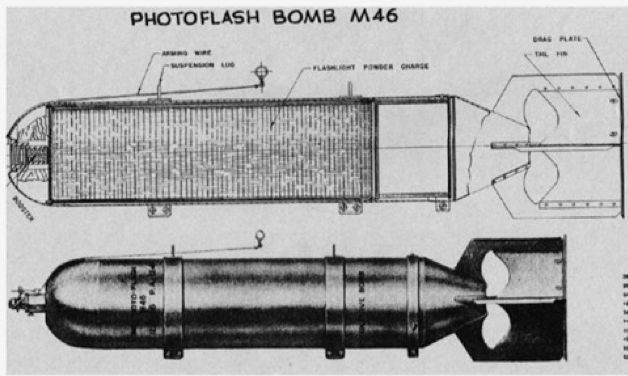
Photoflash Bomb M46
BK261 crashed when a photoflash exploded in the aircraft. This device was the size of a small bomb and was inserted into the bomb chute by one of the crew or sometimes dropped automatically amongst the bomb load. In effect, it was a huge magnesium flare which emitted an extremely powerful white light as it exploded.
How the Photoflash Worked
When the bomb aimer pressed the bomb release button a timer started and shortly after the aircraft’s camera opened. As this was normally at night the flash would highlight the target area triggering a photo and, if all went to plan, the aircraft would return with a photograph.
The photoflash certainly helped the effectiveness of bombing raids and also negated the need for very risky, low flying surveillance. However, the device was essentially a pyrotechnic and extremely volatile. Sadly, if a photoflash exploded inside the aircraft, it would have had tragic consequences. In the case of BK261 the explosion must have wrecked the cabin causing the aircraft to disintegrate in the air.
The Crew of BK261
The following brave airmen lost their lives on the 22nd November 1942:
- Sgt R.H. Church
- Sgt H.W. Bristow
- Sgt F.P. Nettleton
- Sgt T.W. Haver
- Sgt B. Hillberg
Aviation Disasters of the Region
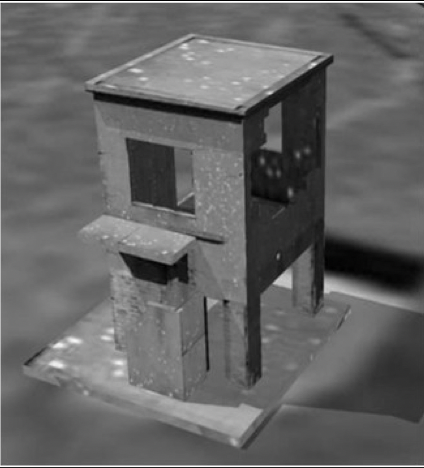
Concrete Observation Tower – Valley Farm (stood until the 1980s)
Research reveals this was not an uncommon event. There were over seven hundred aviation incidents that occurred in the region alone. 1942 seems to have been a particularly grim year, with tragedies involving Wellingtons occurring locally at Compton Wynates, Gaydon, Edge Hill and Bodicote.
The Bodicote Crash
The crash at Bodicote is well documented and is believed to have happened when BK517 hit a tree in bad weather killing all six of her crew. A memorial stone commemorating this can be found approximately 400m south from Wykham Lane in Bodicote.
Other Local Aviation Heroes
Shotteswell also remembers two more aviation heroes.
Pilot Officer William Proffitt White
Age 23
Lost his life when Halifax LK709 failed to return from a bombing raid on Berlin on 28th January 1944.
Flight Engineer Fred Spencer
Age 22 (at time of first tour)
Completed his first tour with Lancaster 106 Squadron and conducted an exceptionally long tour with 630 squadron from November 1943 to October 1944. Subsequently, he received the Distinguished Flying Cross (DFC) awarded for exemplary gallantry during active operations against the enemy in the air.
Fred Spencer was an interesting character who had an eventful 2nd World War. He flew many different types of aircraft: Avro Ansons, Whitleys, Wellingtons and Lancasters, and completed 97 missions over 3 tours. On Fred’s first tour of 36 missions only 4 pilots survived. Later in the War Fred was awarded a bar to add to his Distinguished Flying Cross.
A memorial plaque at the church entrance remembers those in the local area who died serving the armed forces in both wars.
Additional Notes
Location: There is no evidence of the exact location of the crash but it is believed to be near the 9 acre field on the left hand side of the Mollington Lane past the Riding Stables.
Search History: The Pages (who previously owned the land) never found any evidence of the crash whilst working the land.
Sources
- Murray Peterson – A Thousand Shall Fall
- Mark Evans – Midland Aircraft Recovery Group
- http://www.aviationarchaeology.org.uk/research/
- http://www.SJbradley.com/memorial/aircrash.htm
