Life in Shotteswell
An outlook on life in our village.
💭 First-Hand Accounts of Shotteswell Residents
Bill Spencer’s Memories
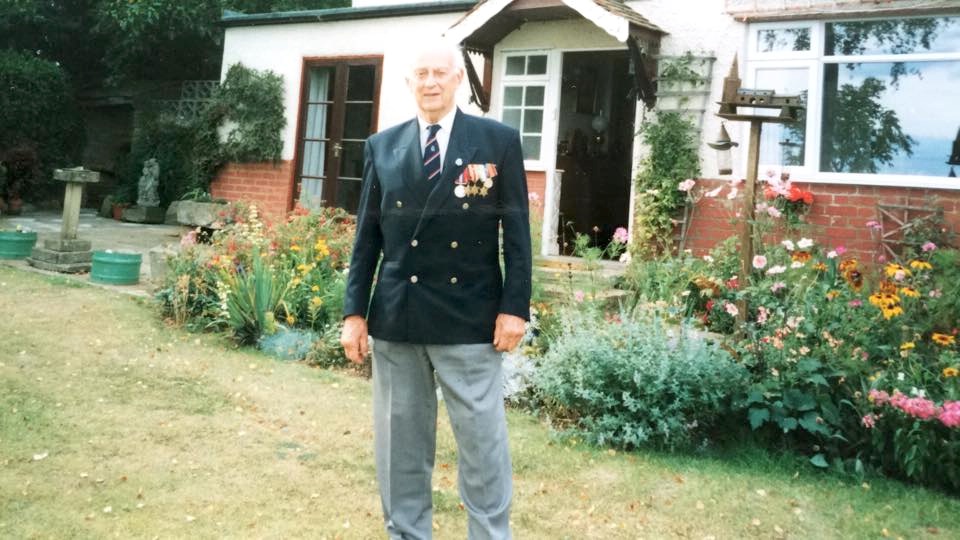
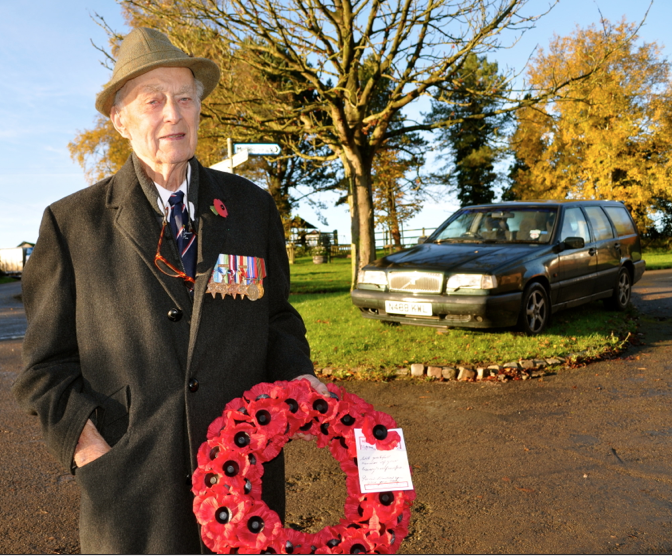
Photographs of Bill Spencer with his Military Medals
In October 2003 Bill Spencer gave a talk on Shotteswell Village History. This was in conjunction with an Exhibition “On the History of the Village” arranged by the Tuesday Club which was held over a weekend in the Village Hall. It was amazing how many villagers supplied lots of old photographs and articles. We had many visitors who expressed delight when spotting relatives or old friends in the displays. Below is the beginning of Bill’s talk which was taped and in future issues we hope to feature more of it.
My grandfather—known as ‘Gentleman Spencer’—married and came to the village in 1891/2 from Aylesmore Farm by Shipston. He was one of three boys and one girl. There were four or five other farms in a triangle between Brailes, Shipston on Stour and Tysoe. These were St Denis, Upper St Dennis, Agden, Littleworth, Chemscote and maybe more. At one time five of these farms were run by Spencers. In the early days of transport they fielded a Cricket Team and toured round by ‘bus’. When father was two years old he lived at College Farm here in Shotteswell, Middle Lane which at that time was thatched as were many others in the village. It had a large orchard and barns around. Grandfather kept about twenty diaries which we still have. Besides being a farmer my grandfather was a JP in Warwick, he helped people in the village with their problems, i.e., measuring allotments of which there were at least three, one was at the bottom of Bakehouse Lane and another in the field past Church Farm, the main village allotment was March Field by the now Riding Stables. He also was in charge of doling out money to the sick. This money came from the rent gathered from a field called Maiden’s Dole, on Oxford–Warwick border. This rent was decided by candle auction, the men would meet in the Old Village Hall on the Green and place a pin quarter way down a candle, on lighting it the bidding would start and the rent was decided when the pin dropped.
I was born in White Cottage and my grandfather died when I was two years old. So most of my information was gleaned by talking to older villagers. Nearly everyone was employed in the village except for the odd person who worked in Banbury, as transport was very difficult. At that time there were six farms in Shotteswell, five of them produced milk and eggs—swedes, potatoes and firewood was also available. Shotteswell had two bakeries, The Flying Horse and the Bakehouse in Bakehouse Lane. Pricketts had a motorvan and Flying Horse has a horse drawn van. Both were very necessary as they supplied a very large area going out as far as Tysoe.
Many men owned a gun, which were used to shoot rabbits, pigeons, pheasants, etc., which supplemented the larder! It was normal to see men walking up the lanes carrying a gun and in the pubs it was not unusual to see a ‘parked’ gun behind the bar. It was quite common for double or single barrelled guns to exchange hands for £5. It’s completely different picture if you are found with any gun these days, there was never any problem with having any guns.
There were two pubs in the village—the Flying Horse, which was also a thriving bakery and The New Inn now called Corner Cottage on the corner of Mollington and Bakehouse Lane. I think it closed in 1934. After the war I would get on my bike or motorbike, with my gun and go to the Warmington Pub or the Hare and Hounds (Wobbly Wheel). I would take my rifle into the pub and no one would lift an eyebrow. I would pass it over the bar to the publican—Jimmy Philips who lived at The Mount before taking on the Hare and Hounds—and say “hang on to that for a few minutes” and have a pint. Reclaiming my gun I would cross the road to the Lancombe fields, behind a transport gate—where the Caravan sales building is now—and shoot some rabbits. Which when I returned to the pub, I sold them and this gave me more money to buy beer and tobacco, which was only a shilling a pint—5p nowadays. In The Mount lived an old friend of my grandfather’s, Tom White and when he was dying they laid straw down the lane so as not to make a noise. He died—May 9th 1923.
John Prickett’s Memories
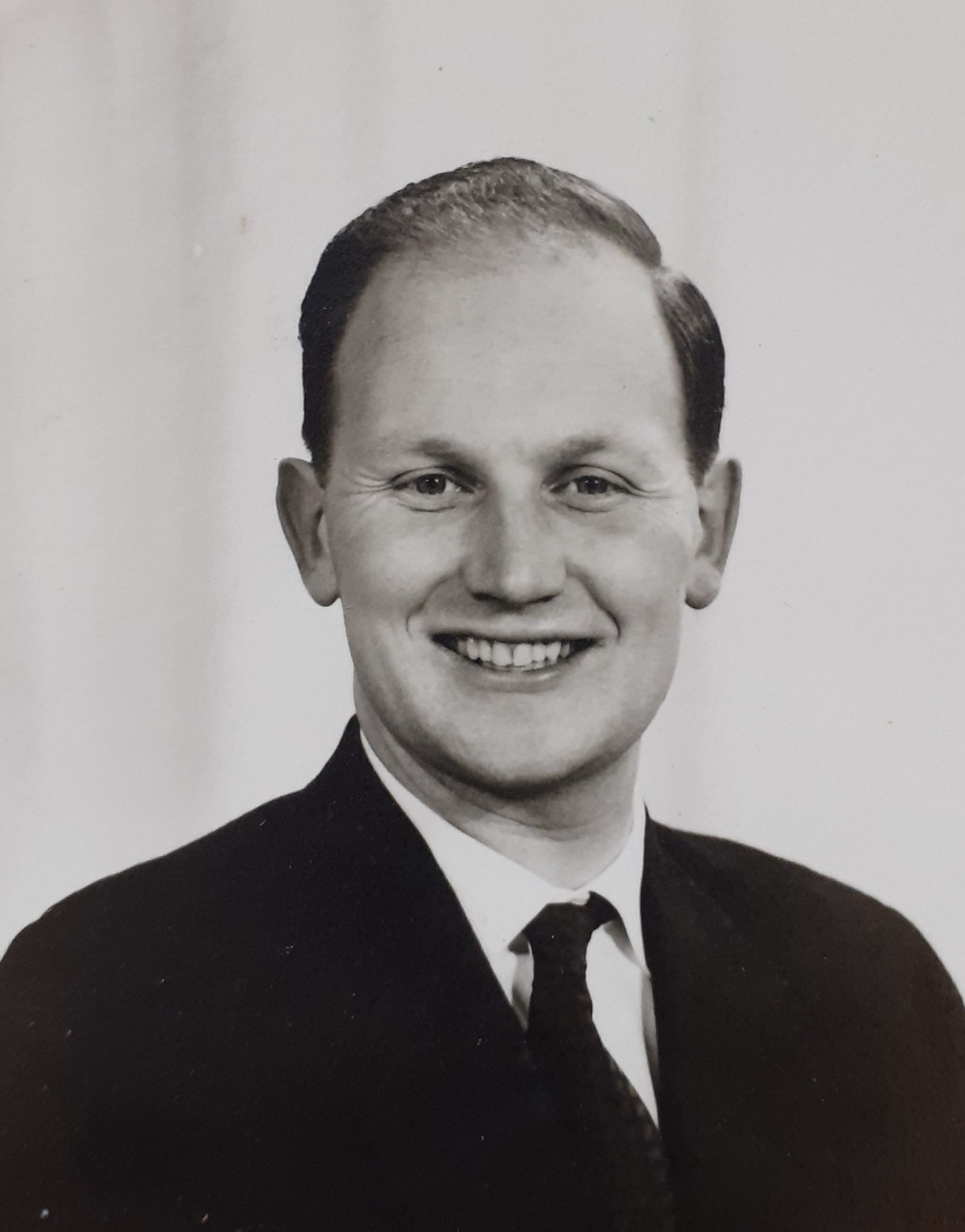

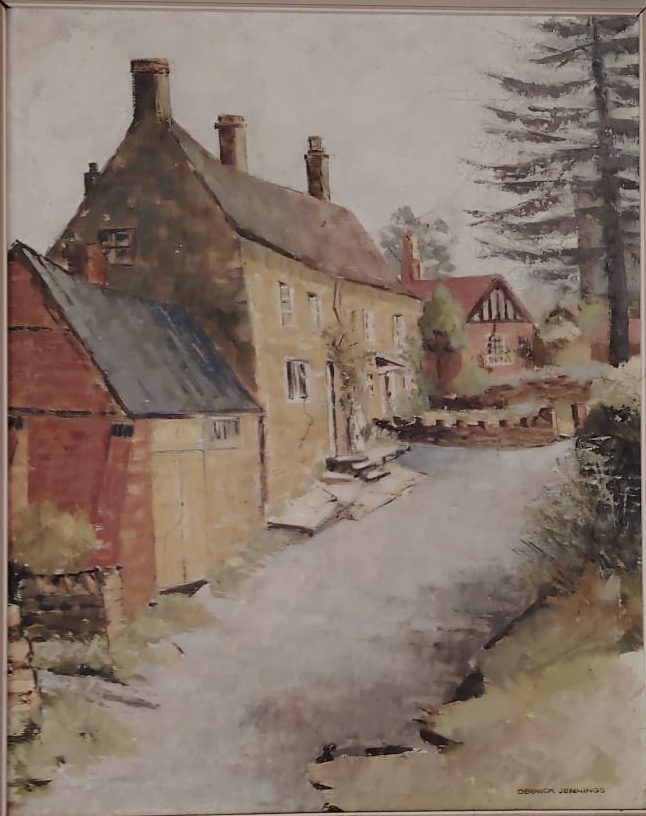
Photographs Courtesy of Martin Prickett – John’s Son
My family has been involved in the production of bread for over 150 years as Millers and latterly as Bakers.
During the First World War, the Government said any person could leave school at 12 years old after taking an exam to show that they had reached a required level of competence. My Father Leslie, started working for his father John at the age of 12 years. His brother Tom, volunteered to be a soldier after a lady stopped him and tried to stick a white feather on his lapel, saying he should be fighting for his country. Tom was killed in Salonika.

John’s Dad – Leslie Prickett
When my father started work in 1915, liquid yeast still had to be collected from Hunt Edmonds Brewery twice a week. Fresh compressed yeast did not become available until the 1930s. When you made your ferment from the liquid yeast, you divided the mixture in half and added flour to the other half. You repeated the procedure the next day. The oven was a side flue with an ash pit. You had crusty bread near the fire and less crusty at the bottom. A wet cloth on the end of a pole was used to clean up any cinders etc. Hence the saying “member of the upper crust” …..the poor having the bottom of a cottage loaf, which might have ash and black cinders on it.
My Grandfather died in 1928 after a long illness and my Father and Uncle Albert made some changes such as a new Drum Bread Mixer with handle on a large wheel which used to kick you if you didn’t hold it correctly. Later in the 1930s, Father fitted a Lister Engine and gears to it which was much better.
Father and Uncle Albert also bought a van to deliver the bread. My Father was married to Louise in 1930 and I was born in 1934. In 1940 the Second World War caused problems, particularly with petrol allocation which were continuously being cut so Father decided to buy a pony and trap, at the same time appealing for extra allocation. About 8 weeks later, we were granted extra fuel, so we sold the pony and trap for a good profit.
After the war, my Uncle Albert said he wanted to leave the partnership, so my Father employed a girl called Elsie from Hanwell who was very good. I had quite a number of jobs – going to the pump and bringing water for Dad to put in the oven so he would have hot water in the morning, chopping sticks and delivering bread on the rounds. We had a new oven in 1953 which caused a fire that destroyed the bakery roof and top floor. However that’s a story for another day!!
♥️ Read more about the life of John Prickett here:
💔 Obituary
Sadly John passed away in 2021, if you would like to read his obituary published in the local newsletter, please see below.
View John’s ObituaryDavid Holman’s Memories of Shotteswell
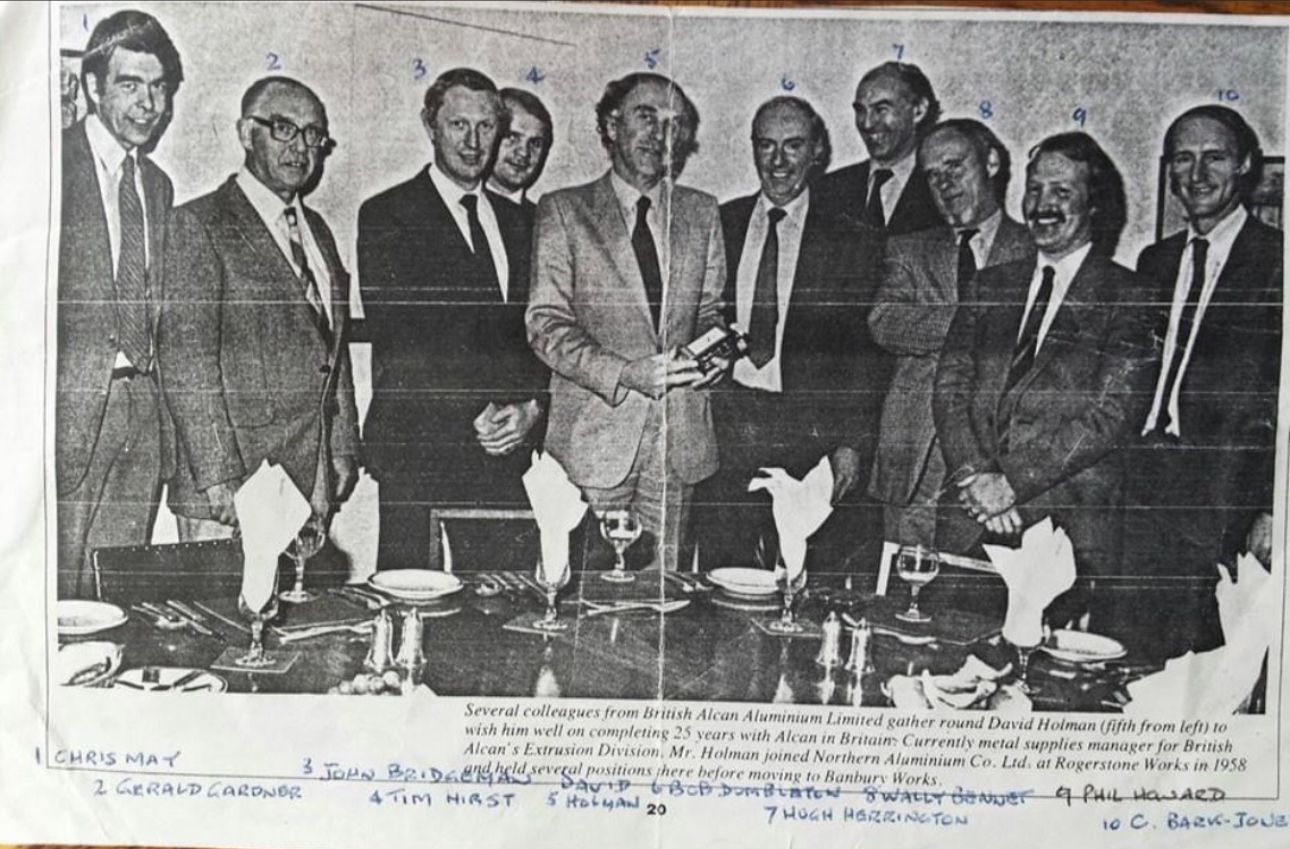
David Holman (Middle) receiving his Silver (25 years) long service award at Alcan
Keri and I moved to Shotteswell in March 1967. There have been many changes in the village during the past fifty-one years, and I thought it might be of interest to those who have arrived more recently, if I outlined some of them.
When we arrived, Shotteswell was a village with a population of around 220 residents. While the population has remained constant, the number of dwellings – houses, cottages, barn and garage conversions – has increased dramatically. In 1967 there were but 65 properties, now there are 105.
There was, of course, no M40. This arrived in 1991 with the opening of the Waverstock to Longbridge Warwick section of the motorway on 16th January. A series of 24 hour censuses of traffic flow, carried out by the M40 Action Group in March annually between 1991 and 1996, showed how quickly the predicted Department of Transport levels of traffic flow were exceeded. Traffic density on a typical weekday in 1996 was 80,243 VPD – the D of T predicted level for 2006 was 76,000 VPD. (It would be interesting to know what it is now!!) All Shotteswell properties received some compensation for noise and interference after the opening of the M40 of 1 to 5.5% based on property values. After the M40 section was opened the A41 was downgraded to B4100. There were two places of worship – St Laurence Church which dates from the 10th century and the Wesleyan Chapel, opened in Chapel Lane in 1854.
Following closure in 1981, the chapel building was used first as a workshop, then a hairdressing salon, before falling into disrepair. It was converted into a private dwelling in 1996. Both St Laurence Church and the Chapel offered Sunday Schools for the village children, organised by people in the village. More recently there has been a children’s group “Messy Church” run jointly with Warmington by Philippa Upton from 2010 to 2014.
The fabric of St Laurence Church requires continuous upkeep which likewise has always been organised by residents. Major projects over the years we have lived here have included the renovation of the bell tower with the addition of a sixth bell, extensive repairs to the tower and the restoration of most of the windows, interior decoration, repairs to several areas of the lead roof and externally repairing and replacing gullies, drains and rebuilding of the churchyard walls and paths as well as the installation of an alarm system to protect the lead roof from theft. The floodlights were put in as part of the Millennium celebrations. The number of churches in the benefice has increased from 2 to 4 in 1985 and to 6 in 2007, now called the Edgehill Six.
Six years prior to our arrival, the Flying Horse, Middle Lane, formerly a public house, had been opened as a general store and Off Licence. The stable block was converted into a Post Office. The shop was closed and the property was sold in 1988, and this too is now a private house. The Post Office continued to be located at various venues and now still operates on Monday mornings, having returned to its original location The Old Post Office’, where it was when we first arrived in the village.
As was common everywhere, for many decades there was a daily milk round for a while. There is now a round that again serves the village, although not on a daily basis. Fresh fish still comes to the village too with a van driving through on a Wednesday morning. When we first knew the village, there was a mobile butcher and several generations of the Prickett family have been involved in the production of bread over 150 years first as Millers and latterly as Bakers based at the bakery in Bakehouse Lane and delivering from here to many local villages. We now have a farm shop and butcher opened opposite The Falcon. Now there is an endless stream of delivery vans responding to online orders. A house next door to the Farm Shop was the home of the Village Policeman, who also looked after Warmington.
Increased car ownership and changes in lifestyles has led to the reduction of the daily bus service in the 50s and 60s, to the present once weekly return service to Banbury on a Thursday, Banbury market day.
In the 1960s, a Nissan hut on the village green served as the Village Hall. Following the closure of the school, the school building was acquired by the village and an extension was built to house, the toilets, the extended building then became the Village Hall, opened in 1974, and over the years a considerable amount of work has been carried out, including decorating, new lighting and heating fitted, some windows replaced and a new modern kitchen installed. Externally the tarmac yard has been replaced and the boundary wall and railings rebuilt. For many years, the Parish Council discussed the possibility of securing a village playing field. A lease was eventually signed with Brasenose College for the rent of part of the field opposite the Village Hall. The playing field, laid out with a range of play and exercise equipment including a football area plus goal posts and a zip wire was opened in 2005. It has proved a very popular destination and its existence would not have been possible without the persistence of Valerie Ingram.
Warwickshire County Council Mobile Library, an excellent service which has been visiting Shotteswell since 1952 and which now calls here on a Tuesday morning, once every three weeks. For a while there was also a small children’s library, organised within the village which operated from various locations including Village Hall and Valerie Scott’s garage (Corner Cottage).
When I took over as Footpath Officer for the parish in 1989 I carried out a survey of the Shotteswell footpaths and found them to be in a very poor state. With materials and some training supplied by WWC, a small team, David Holman, John Crocker and Mike Palmer set about improving the paths; in addition to clearing vegetation, hedges, cutting grass paths, virtually all the stiles and way markers were replaced and new bridges, stiles and some dog gates were also installed. An attractive leaflet showing the routes in the village and connecting to other villages was produced and distributed to all houses and a large-scale map displayed on the wall of the Village Hall. There were 5 public footpaths and two permissive ones were created with the help of the relevant land owners to provide circular routes, the Roger Peel Millennium and the Jim Page Memorial footpaths have proved exceptionally popular. The Page family generously had the Jim Page’ permissive route converted into a formal public right of way, and the path was dedicated as such in 2017. WCC no longer provide a council Road Man. Back in the 60s and 70s we were very fortunate to have Billy Waldon as our council Road Man and he kept the verges and gullies in excellent order, resulting from Council changes he was then transferred to a bigger team to look after more villages.
Shotteswell Primary School opened in the 1880s and was staffed by one or two teachers. As a result of changes in education policy, combined with falling pupil numbers the school closed in 1973. The designated village schools for Shotteswell children then became Fenny Compton Church of England Primary School or Farnborough Church of England Primary School, and when the latter closed, the Fenny Compton Church of England School in Fenny Compton.
The Tuesday Club was started by Philippa Upton and Heather Zeale in 2003; both were newcomers with young families. They thought it would be a good idea to start a club for people of all ages to get to know each other. Besides meeting in the Village Hall each Tuesday morning where there are talks, quizzes, games etc. visits are arranged to various places. It shows how popular the club has become as it is still running today.
In September 2011 Regenco, a renewable energy developer announced that it was exploring the possibility of building a wind farm adjacent to the M40 motorway between Shotteswell and Hanwell, all the local villages opposed the project and it was eventually rejected in June 2012 due to the possible danger due to close proximity of the Shotteswell Flying Field. I apologise for any inaccuracies in the text.
👨🏻🏭 Alcan Aliminum
Read about Alcan during WW2, where David received his long service award
Read More about Alcan’s role in WW2Norman Jonas Page
A.K.A. Jim Page
Born: 22/01/1917
Died: 01/05/1999
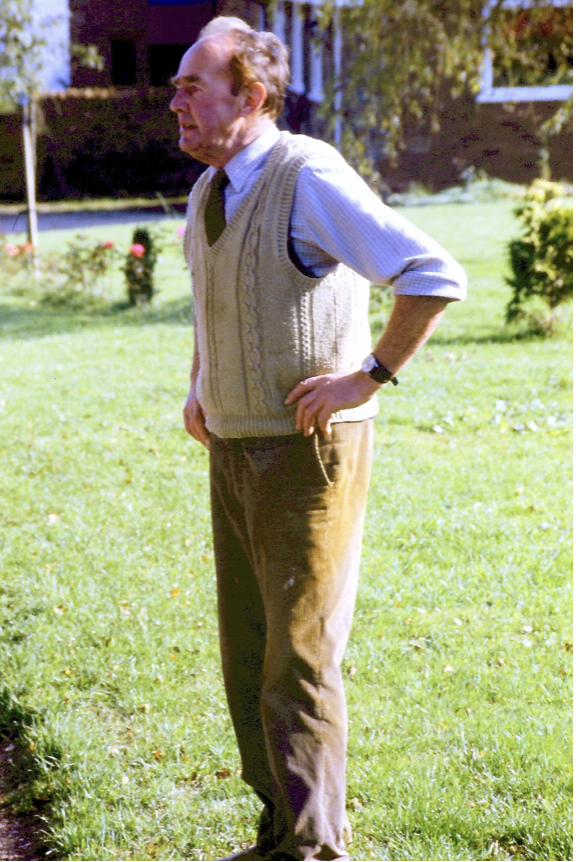
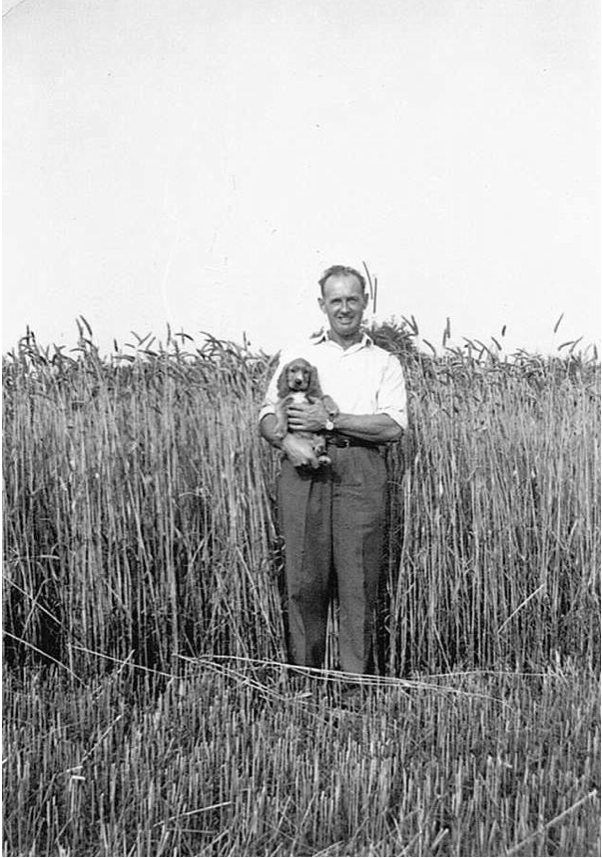
Photos of Jim Page provided by his son, Nick
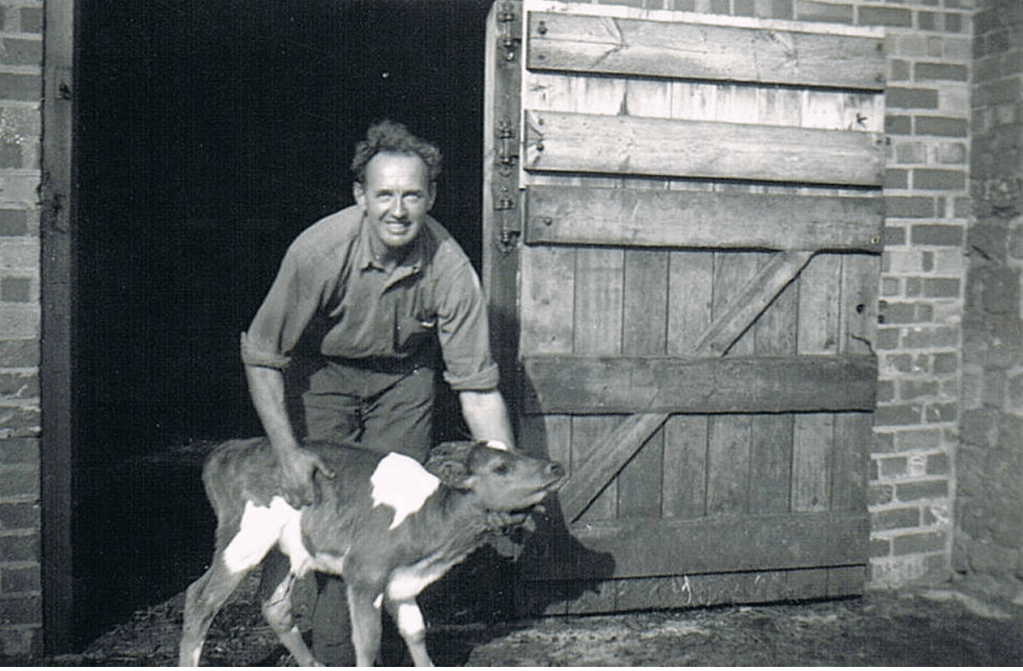
Norman Jonas was the son of Florence and Ernest Page and grew up with sister Sybil at ‘Cottenham Farm’ in the picturesque village of Great Tew. The huge farmhouse, situated in glorious countryside midway between the village and the B4031 Deddington Road, was one of several tenanted farms that made up the vast Great Tew Estate. Birmingham industrialist Matthew Robinson Bolton acquired the Estate in 1815 and planned the village’s expansion, but its history stretches back to at least the Domesday Book. He added Gothic doorways and other features to existing cottages to create a unique, picturesque look designed to be viewed from the main house. Always the joker, the family once had a wonderful photo of Norman as a young lad incarcerated along with a mate in the wooden stocks, located on the green opposite the renowned ‘Falkland Arms’ pub.
In late 1937 Ernest, together with his son, made the bold decision to move from working a tenancy to purchasing their own farm outright, with the result being the acquisition of ‘Laurel Farm’ in Shotteswell for the sum of 4750 pounds. The 230 acres of land represented an ideal investment for a mixed farming enterprise, comprising good quality arable soils, grassed paddocks, as well as a substantial farmhouse and outbuildings.
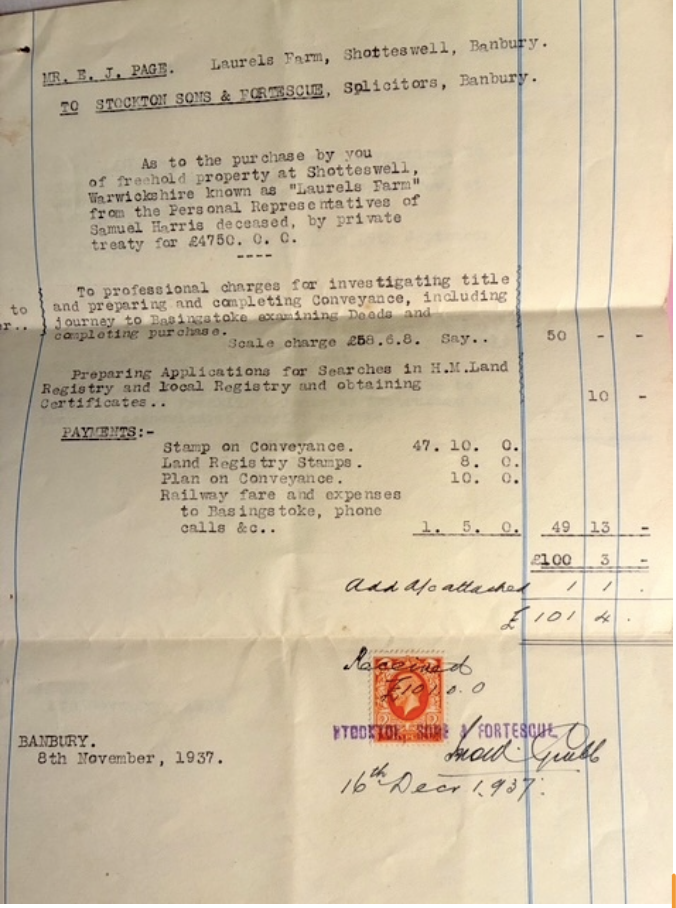
Bill of Sale for Laurel Farm
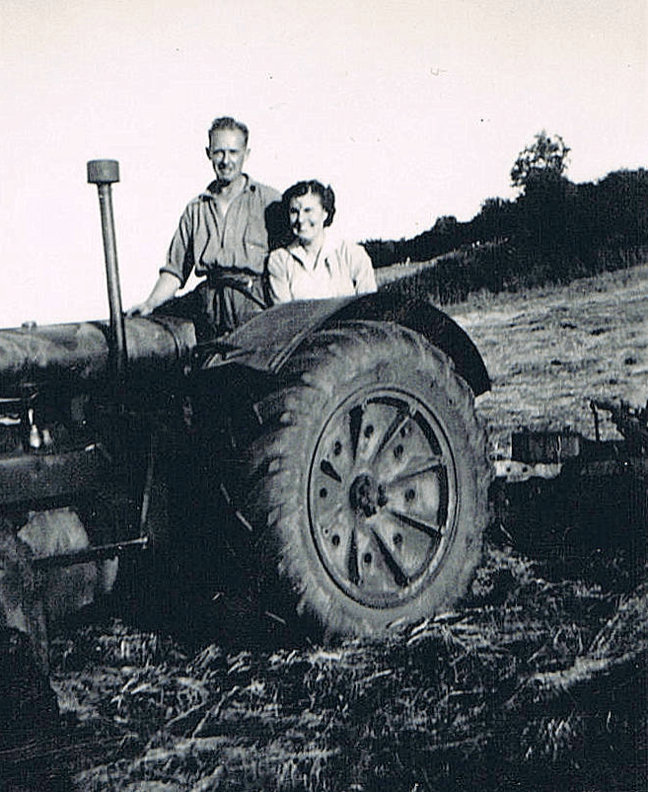
Amidst WW2, the need to continue to farm the land became imperative and so Norman, with the aid of some allegedly attractive ‘land girls’, worked tirelessly to help feed the country. It’s a fair bet he would have preferred their company to the Italian POW’s who were also assigned labouring duties. As father Ernest’s health began to decline, Norman gradually took on greater responsibility and eventually outright ownership of the farm, always demonstrating great business acumen along the way. The jokey exterior always concealing a sharp financial mind. Nobody is quite sure how and when he was to become colloquially known as ‘Jim’, but the nickname firmly stuck throughout the remainder of his lifetime.
The farmland once encompassed what is now the housing in New Road, plus ‘Hillcrest’, ‘Aylesmere’ and ‘Hill Cottage’. The latter two homes were built as tenancies, with farm labourer Bill Cleaver and his wife, Marjorie, living in ‘Hill Cottage’. ‘Hillcrest’ was originally occupied by a couple of ladies who allegedly encouraged Jim to take up signing lessons! It was to become the home of Florence and Ernest until their passing, after which it became the much-loved residence of the Spencer family.
However, there is considerably more to the story of surrounding the residents of ‘Aylesmere’. Godfrey Golder, wife Katie and young daughter Beryl became the first tenants after moving to Shotteswell from nearby Avon Dassett. On Godfrey’s return from the war he took up a rather ‘jack-of-all-trades’ position with his employer Elizabeth Profumo and when she moved from her ‘Avon Carrow’ home to ‘Mount Stewart House’ in Shotteswell, he and the family duly followed.
Now, young Jim had a bit of a habit of ‘playing the field’ when it came to dating. Rumour has it he was courting a certain Margaret Bull, daughter of George & Ida at ‘Oak Dene’ across the road from Laurel Farm, when at the same time, a certain Beryl Golder took his eye when she returned home from working at Bourne’s Department Store in London. Apparently, he duly suffered the wrath of Margaret when she was unceremoniously dumped in favour of the eighteen-year-old brunette, Beryl. The romance quickly blossomed despite the age difference and after a short engagement the couple were married at St Laurence Church in Shotteswell on 23rd July 1955, after which followed a honeymoon at the seaside town of Bognor Regis.
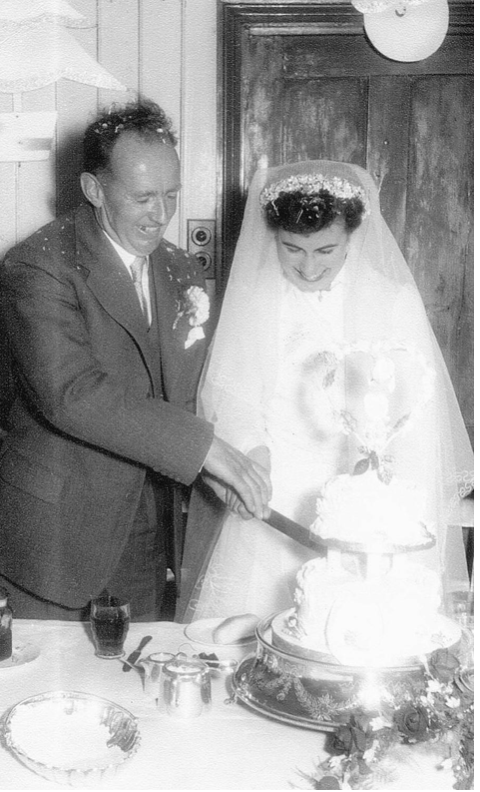
Jim and Beryl Page at their Wedding
They soon settled into life at Laurel Farm and it wasn’t long until baby Nicholas came along… …then baby Robert…then baby Alan! When 4th baby boy Jonathan came into the world in 1965, mother-in-law Katie was famously quoted as saying “Do be careful Jim!”, but by this time the contraceptive pill was widely available, which helped his cause somewhat.
Back in the day, farming safety measures were almost non-existent and Jim was not immune to the odd accident involving machinery. Perhaps the most gory incident was when he got his hand stuck in the rear end of a hay baler, resulting in in his right thumb being almost severed. Undeterred, he drove himself off to the Horton General with the digit dangling by his side. A more comical episode was when he lost balance and fell backwards into the sheep dip, fortunately managing not to drown in the murky, green, chemical-infused liquid.
The sound of the bells ringing out from St Laurence Church has been enjoyed by generations in the village and before the formation of the bellringers group, Jim would somehow manage to ring a peel of three bells on his own via one in each hand, plus one tied to his foot! One of his favourite sheepdogs, Rover, would often sit outside, howling along in some kind of canine appreciation. Jim was also a dedicated churchwarden and could be regularly distinguished by him singing his favourite hymns with fervent gusto.
As was the case with many local farmers, Jim followed the local fox hunts, originally on horseback and later, on foot. Foxhill Bank on the farm was true to its name and featured several dens. He was able to imitate the sound of a hunting horn extremely realistically (as well as a cuckoo!), which may well have unwittingly led to mass confusion at times amongst followers on horseback! He once participated in a local point-to-point race, a jumping event traditionally reserved for hunt riders and their horses. Unsurprisingly, Jim frequently attended national hunt jump race meetings at Stratford, Warwick and Towcester, loved a flutter and possessed a canny knack of winning the old ‘Tote Double’ or ‘Tote Treble’ via the carefully selected purchase of multiple ticket units.
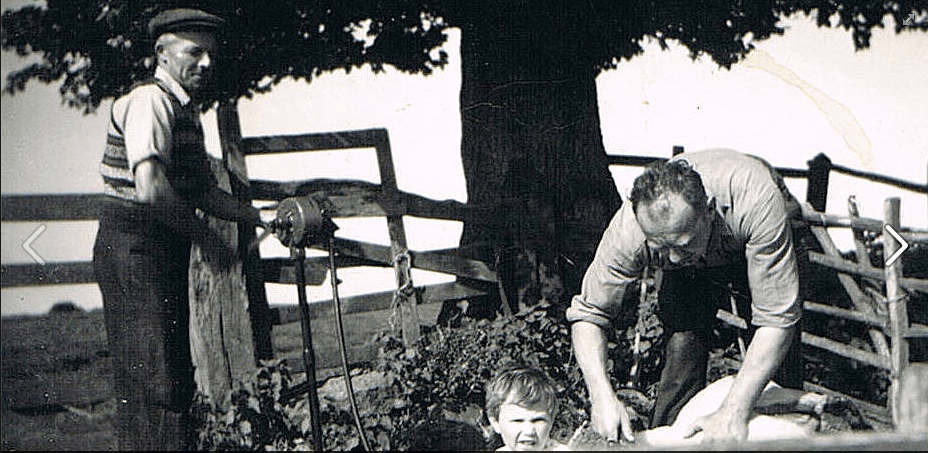
Jim lived and breathed the land and not being content with simply running stock or nurturing crops he always had a large patch of a field set aside for vegetable growing. Copious amounts of peas, runner beans, carrots, potatoes, plus anything else that took his fancy, would year- on-year be harvested, not just for the family, but for others in the village as well.
Laurel Farm was often generously made available for a variety of village social and sporting events. These included several fetes in the Home Ground field, Queen Elizabeth II Silver Jubilee celebrations in the farmyard, Guy Fawkes bonfire nights, parties in the huge grain barn, Scout Group activities, as well as providing pitch facilities for Shotteswell Youth Football Club, ably coached by the late Tony Williams. In addition, many children will fondly remember numerous ad-hoc play days together riding in grain trailers, bombing around in old cars, riding ponies, or having impromptu football kickabouts. What a childhood it was, although what a nuisance we probably all were!
During the 1970’s, Jim began forming a close farming alliance with nearby potato farmer Robin Hall, whose large operation was based out of ‘Glebe Farm’, just outside of Horley. Eventually, with age catching up on him, Jim assigned a tenancy for Robin to farm the total Laurel Farm acreage, minus of course, a dedicated vegetable growing area! Some folk may have been surprised that none of the boys were to continue the Page farming legacy, but Jim would often reiterate how tough the 24/7 life could be. Indeed, Robin Hall was to subsequently have some rough years, most notably when his total potato crop once rotted in the ground due to bad weather.
In 1980 the family received a devastating blow when the life of young son and brother, Alan, was tragically cut short by terminal illness at the tender age of just 17. The subsequent years were tough for all, but particularly for Jim, who’s faith was severely tested and he was particularly missed at church for a subsequent amount of time.
With eldest son Nick having completed his Cartography Diploma at Luton College and moving to St Albans in Hertfordshire for his first job, Jim and Beryl made the tough but sensible decision to downsize in 1983. The conversion of ‘The Manor’ farm buildings by a local builder had caught Jim’s eye and he became determined to secure one of the old cowsheds being attractively refurbished into a cosy 2-bedroom bungalow complete with sweeping views over the valley towards Mollington.
Of course, there was only one way for Jim to move home and that was to use the tractor and trailer to transport family belongings on the very short journey down Back Hill to ‘Manorside’! What weighed more heavily on his mind was the bridging loan required to purchase said new home, as Laurel Farm remained stubbornly on the open market. Fortunately, a certain Mike Kipping and Catherine Evans came to Jim’s rescue, purchasing the farmhouse together with part acreage from the Home Ground field.
Mike will probably endorse the fact that Jim initially questioned his agricultural management skills on pretty much a daily basis, which must have been quite infuriating, but for anyone who has the privilege today of touring the farmhouse, outbuildings, paddocks and livestock, the projects carried out over the subsequent years by the team represent nothing short of a phenomenal transformation.
Jim eventually regained his joy for life and some credit there should be given to larger-than- life neighbours Gilly and Steve Mathers. One particular skit stands out, with Steve creating a spoof article for the Banbury Guardian featuring Jim as master French vintner ‘Jaquot Campaire’ the creator of a Beaujolais Nouveau and hailing from the twinned-village of ‘Peu Lanqueville’. The photo features Jim in a resplendent French beret, an item of apparel that he was often seen wearing around the village.
Sadly, at a family gathering in the Spring of 1999, a severe warning shot was fired when Jim suffered an aneurism and was transported by ambulance to the Horton. Despite surviving the incident, on May 1st, a week later, a second attack took his life whilst still in hospital at the age of 82. For many it was hard believe that such as icon of village life was no longer a part of it.
The family continued to retain Robin Hall as a tenant, as Jim would have wished, until ill-health forced Robin to reluctantly retire. This seemed the right time for the family to evaluate the future of the farmland, tended and loved for so long by Jim. Its eventual sale in 2018 helped to secure the financial futures for both Beryl and her sons, but they were also determined to ensure Jim’s legacy was to live on. After liaison with the Village Footpath Group, a ‘permissive footpath’ was designated from the Dutch Barn, along the top of Foxhill Bank and down the hill to Mollington Road, creating a beautiful circular walk for locals to enjoy. The route is now officially named the ‘Jim Page Memorial Footpath’ and has been gazetted by Warwickshire County Council as a permanent pathway, complete with unique signage and a memorial bench.
“The best Dad and the best childhood any lad could ever wish for.”
Nick Page
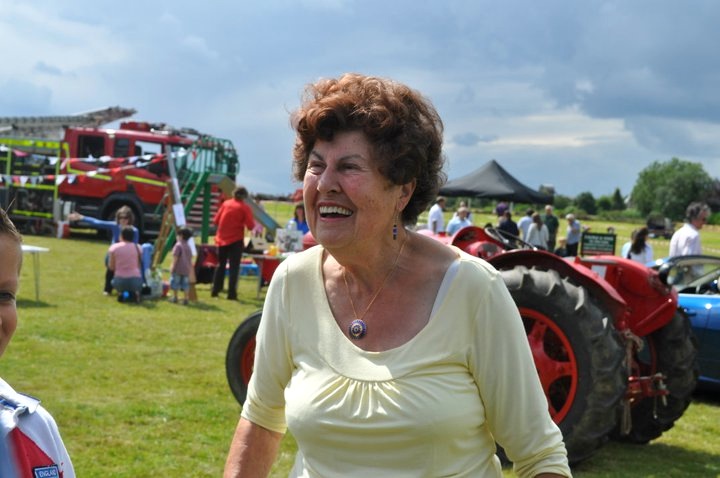
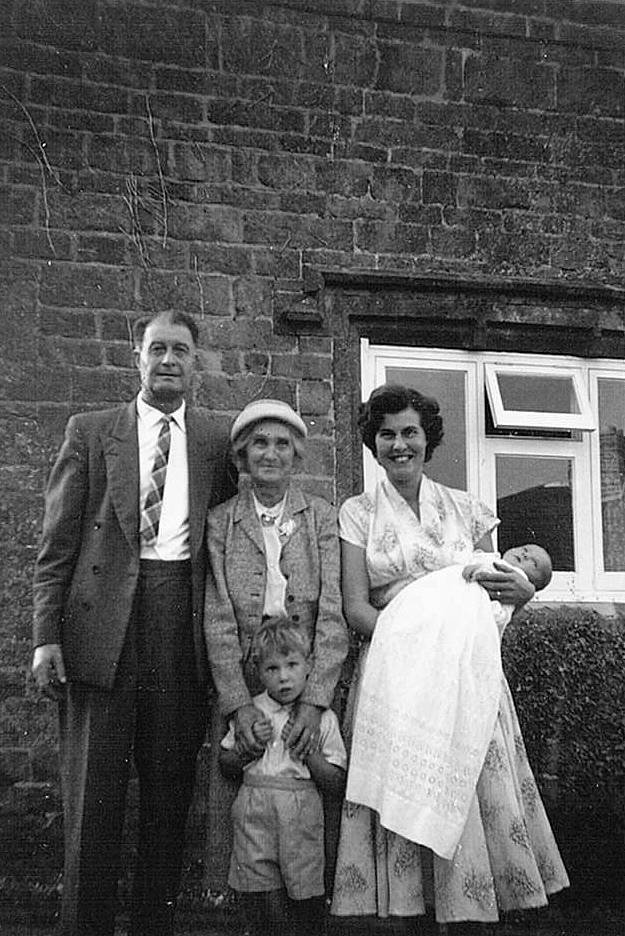

Poems From Villagers
Here is a collection of poems written by the villagers of Shotteswell, capturing the essence and beauty of village life.
SHOTTESWELL by Roy W Jenkins, Aged 92
Travel all over Britain and you will find
So many villages that will ease your mind.
Pretty as a painting you’d hang on your wall,
Most have church spires that stand out tall.
But occasionally, now and again, you will find
Some villages are of a different kind.
Yes, they have tall church spires just the same,
But this is where resemblance does not remain.
Now one village I know is not far from me
It is so different, it has great dignity.
Built on a steep bank or a small hill,
To live there, you need lots of skill.
Now this small village that’s full of charm
Has the name of Shotteswell and is so calm.
People live in houses built on uneven ground,
With sloping gardens all around.
I have known Shotteswell all my life,
Especially as it concerns my wife,
Whose family lived there in younger days
Bonehams and Pages, being their names.
Some great names and friends from the past,
To some, their memories will always last.
Let’s take Uncle Bert and Auntie Nellie Page
Loved by children of any age.
With their kind nature of love and care,
With all the children they would share.
Sweets and cakes they would give galore
Not one child was turned away from their door.
Prickets, Pages, Gilberts, Spencers, Bonehams
Shotteswell names picked out of a hat,
Whose relatives go a long way back,
Looking after the village in many ways,
Especially those far-off days.
The village post office, I have to say,
Is the main anchor in many a way.
The name of Gilbert is very large,
Because our Valerie is in charge.
Entertainment in the village of Satchwell Bank
Was The Flying Horse public house open every day
A place for darts, dominoes, and cards for men to play
The landlords were Mr. and Mrs. Betts,
Very nice, I have to say,
Who made their customers welcome every day.
Mumford the butcher came to the Village twice a week,
With his tasty sausages, such a treat.
Sorry to say, those days have gone;
Amenities like that are long gone.
No more school like it was in the past,
Due to the dwindling size of the class.
The school that was is now the Village Hall,
Where people meet and entertainment for all.
I close this poem and mention Bill Spencer,
No longer with us, sorry to say.
A friend of our family in his day,
Also his wife Eileen, whom we visit still today
Who is fit and healthy, pleased to say.
💌 Letters from Former Residents
In October 1988, British Telecom attempted to remove our iconic red telephone box, thanks to efforts from local residents and the Parish Council, it was saved and remains a beloved feature of the village. After it was published, it sparked a wave of nostalgia and appreciation for the village’s history, here is one example:
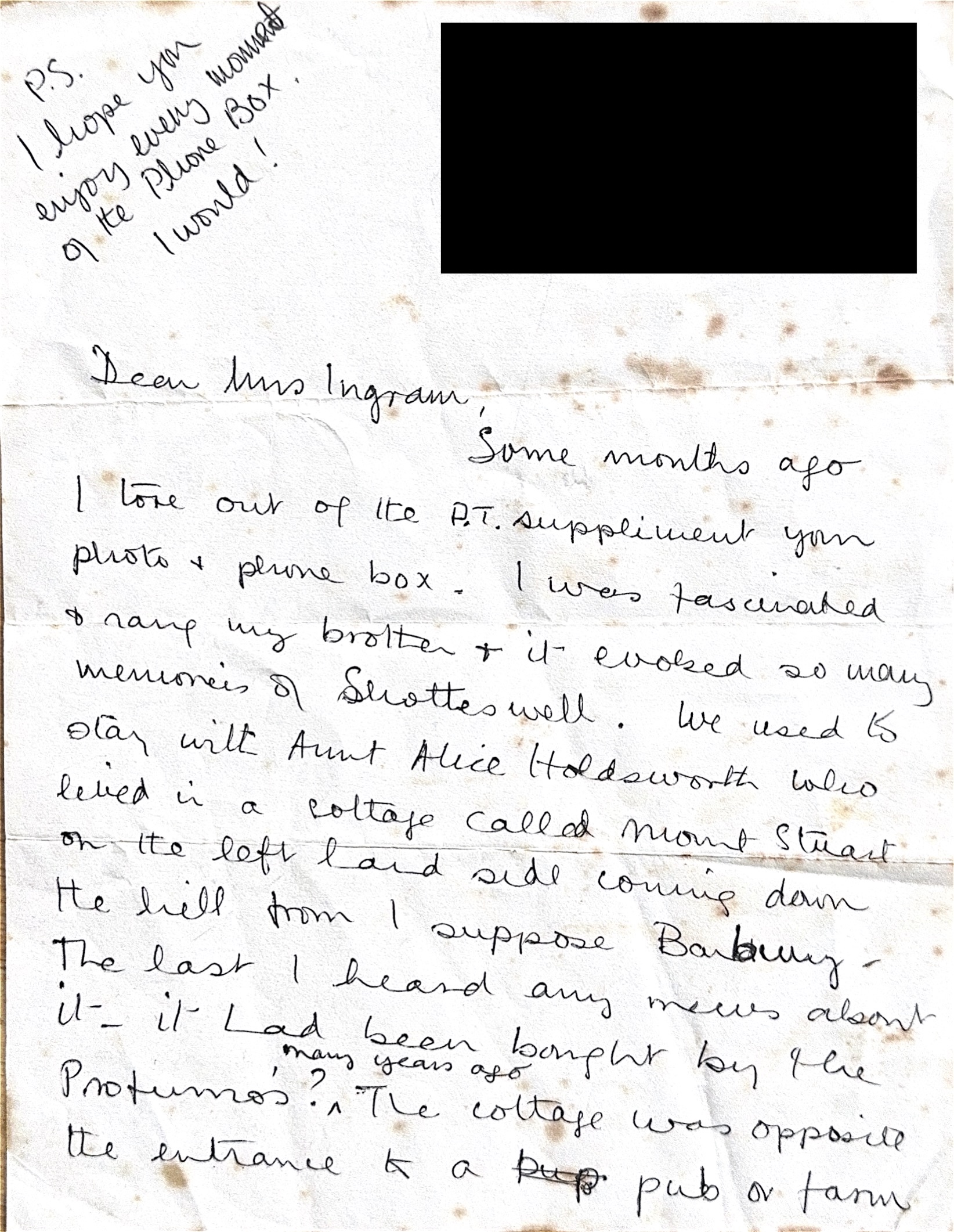
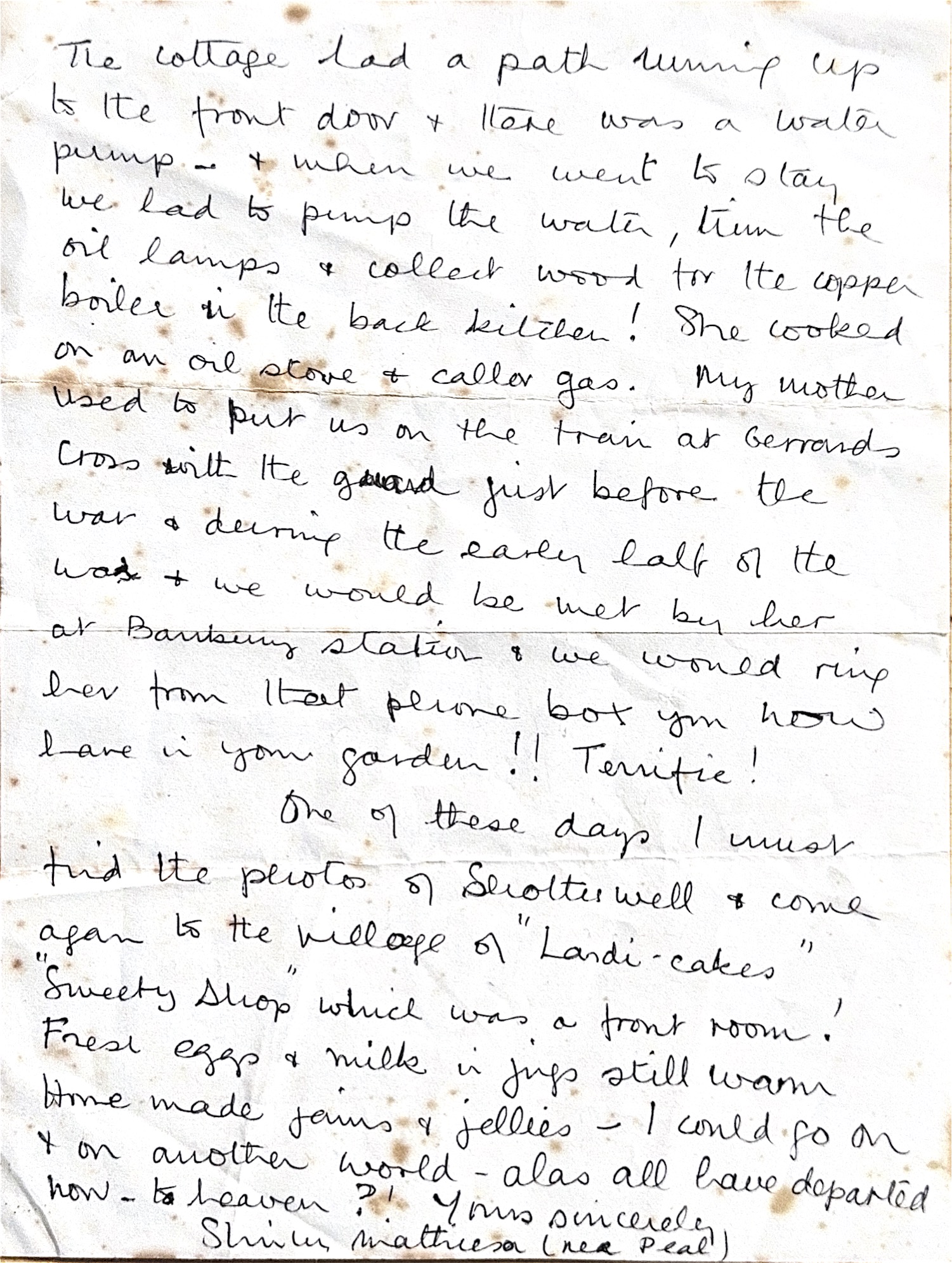
Letter received from Shirley Mattheson in October 1988, a former resident of Shotteswell
Folklore & Old Sayings
Life in the 1500s
- Most people got married in June because they took their yearly bath in May, and they still smelled pretty good by June. Brides carried a bouquet of flowers to hide body odour. Hence the custom today of carrying a bouquet when getting married.
- Baths consisted of a big tub filled with hot water. The man of the house had the privilege of the nice clean water, then all the other sons and men, then the women and finally the children. Last of all the babies. By then the water was so dirty you could actually lose someone in it. Hence the saying, “Don’t throw the baby out with the bath water!”
- Houses had thatched roofs—thick straw piled high, with no wood underneath. It was the only place for animals to get warm, so all the cats and other small animals (mice, bugs) lived in the roof. When it rained it became slippery and sometimes the animals would slip and fall off the roof. Hence the saying “It’s raining cats and dogs.”
- There was nothing to stop things from falling into the house. This posed a real problem in the bedroom where bugs and other droppings could mess up your nice clean bed. Hence, a bed with big posts and a sheet hung over the top afforded some protection. That’s how canopy beds came into existence.
- The floor was dirt. Only the wealthy had something other than dirt. Hence the saying, “Dirt poor.” The wealthy had slate floors that would get slippery in the winter when wet, so they spread thresh (straw) on the floor to help keep their footing. As the winter wore on, they added more thresh until, when you opened the door, it would all start slipping outside. A piece of wood was placed in the entrance-way. Hence: a threshold.
- In those old days, they cooked in the kitchen with a big kettle that always hung over the fire. Every day they lit the fire and added things to the pot. They ate mostly vegetables and did not get much meat. They would eat the stew for dinner, leaving leftovers in the pot to get cold overnight and then start over the next day. Sometimes stew had food in it that had been there for quite a while. Hence the rhyme: Peas porridge hot, peas porridge cold, peas porridge in the pot nine days old. Sometimes they could obtain pork, which made them feel quite special. When visitors came over, they would hang up their bacon to show off. It was a sign of wealth that a man could, “bring home the bacon.” They would cut off a little to share with guests and would all sit around and chew the fat.
- The cooking pot would be kept hot all day and food put in it as available. If a favoured visitor arrived they may be offered some food and they would take ‘pot luck’ as to what they would eat.
- Those with money had plates made of pewter. Food with high acid content caused some of the lead to leach onto the food, causing lead poisoning death. This happened most often with tomatoes, so for the next 400 years or so, tomatoes were considered poisonous.
- Bread was divided according to status. Workers got the burnt bottom of the loaf, the family got the middle, and guests got the top, or the upper crust.
- Lead cups were used to drink ale or whisky. The combination would sometimes knock the imbibers out for a couple of days. Someone walking along the road would take them for dead and prepare them for burial. They were laid out on the kitchen table for a couple of days and the family would gather around and eat and drink and wait and see if they would wake up. Hence the custom of holding a wake.
- When the Church started running out of places to bury people, they would dig up coffins and would take the bones to a bone-house, and reuse the grave. When reopening these coffins, 1 out of 25 coffins were found to have scratch marks on the inside and they realised they had been burying people alive. So they would tie a string on the wrist of the corpse, lead it through the coffin and up through the ground and tie it to a bell. Someone would have to sit out in the graveyard all night (the graveyard shift) to listen for the bell; thus, someone could be saved by the bell or was considered a dead ringer.
- They used to use urine to tan animal skins, so families used to all pee in a pot & then once a day it was taken & sold to the tannery. If you had to do this to survive you were “Piss Poor”. But worse than that were the really poor folk who couldn’t even afford to buy a pot—they “didn’t have a pot to piss in” & were the lowest of the low.
- Later in history, people still would collect urine for sale to a collector who came around regularly. This urine was used in the production of early plastics such as Formica, which is a type of urea plastic. This continued until chemists developed synthetic urea.
- At the tannery people used to have to tread on the skins in the urine in their bare feet all day to get the grease from the hides. People who did this were called fullers, the origin of the surname.
A Saying About Bees said in Shotteswell
Is worth a load of hay.
A swarm of bees in June,
Is worth a silver spoon.
A swarm of bees in July,
Isn’t worth a fly.
Firewood Rhymes
Beechwood fire burns bright and clear, If the logs are kept a year.
Store your beech for Christmastide, With New Year holly cut beside.
Chestnut only good, they say, If for years ‘tis stored away.
Birch and firewood burn too fast, Blaze too bright and do not last.
Flames from larch will shoot up high, Dangerously the sparks will fly,
But ash wood green and ash wood brown, Are fit for a queen with a golden crown.
Oaken logs, if dry and old, Keep away the winter cold.
Poplar gives a bitter smoke, Fills your eyes and makes you choke.
Elmwood burns like a churchyard mould, E’en the very flames are cold.
Hawthorn bakes the sweetest bread, So it is in Ireland said.
Applewood will scent the room,
Pear wood smells like flowers in bloom.
But ash wood wet and ash wood dry a king may warm his slippers by
